Two Photons Flying Apart Over Geneva
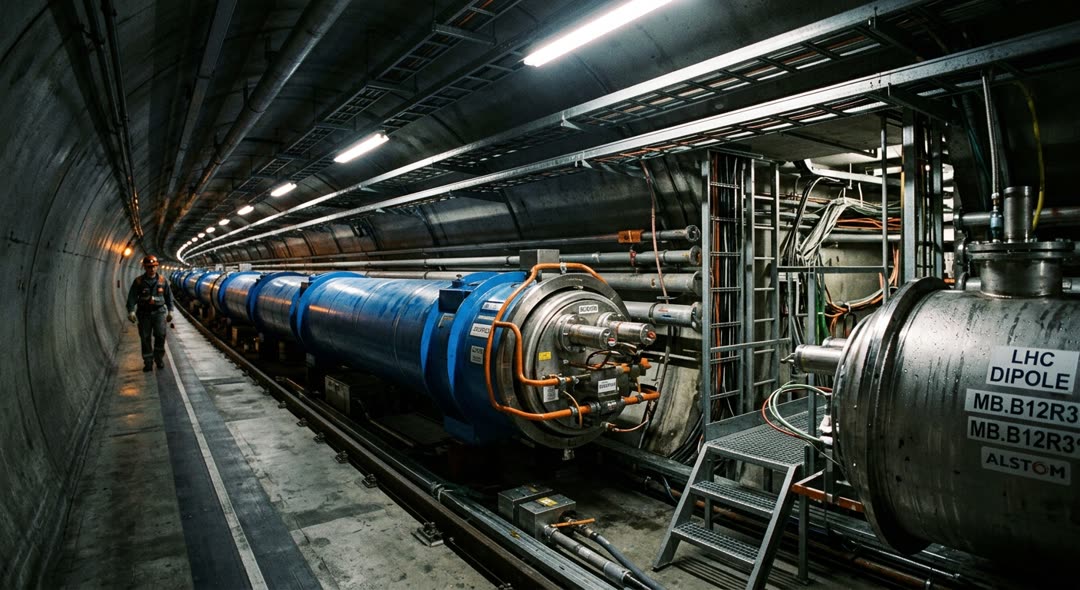
Twenty-seven kilometres of ring, deep underground near Geneva. For more than two years, beams of protons had been accelerated to almost the speed of light and smashed into each other inside it. Nobody in the auditorium had slept much.
At CERN, outside Geneva, the numbers finally held. CMS, one of two enormous detectors at the Large Hadron Collider, had reached a local significance of 4.9 sigma at a mass of 125.3 GeV. ATLAS, the other detector, designed and built by thousands of people over two decades, had come in at five sigma. Two machines, two answers, and they matched.
The particle had been hunted for almost fifty years. It was the last thing the standard model of matter still predicted and nobody had ever seen, the missing piece thought to hand every other particle its mass. Someone had called it the God particle, and the name annoyed the physicists who had given their careers to finding it. In December 2011, the ATLAS and CMS teams had each reported tantalising hints of a Higgs-like boson, though those readings carried only three sigma of confidence, enough to quicken the pulse and not enough to say the word out loud.
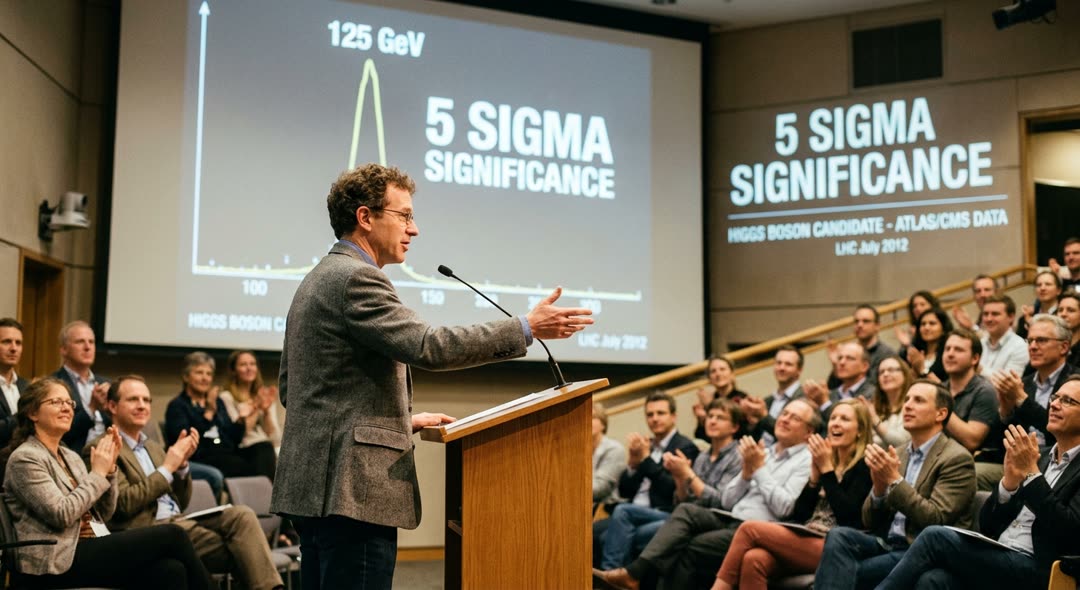
On the morning of July 4, 2012, a single seminar links the CERN auditorium to a hall in Melbourne, where the International Conference on High Energy Physics is already underway. The two collaborations have spent the run kept blind to each other’s numbers, each analysing its own data so that neither team could nudge its result toward the other’s answer. One after the other, they read out what they have found.
ATLAS puts its local significance at five sigma, the threshold physicists hold before they will use the word discovery, a less than one-in-a-million chance the signal is only a fluke. Both detectors settle on the same object: a particle with a mass of 125 to 126 gigaelectronvolts, roughly 130 times the mass of a proton. Two experiments, built and run by separate teams, arrive at the same place along the mass scale. It is the most massive boson anyone has ever seen.
The theory itself was old by now. Robert Brout, one of the physicists who had first worked out how the particle could give mass to matter, had died in 2011, a year before the detectors settled on their number. He did not hear the announcement.
By the end of the seminar, both machines had converged on a single object near 125 gigaelectronvolts, the heaviest boson yet observed, and the last prediction of the standard model that no one had ever seen was no longer only on paper.
Near Geneva, there is a ring under the ground. It is 27 kilometres long. For more than two years, tiny particles called protons moved inside it. They moved almost as fast as light. Then they smashed into each other.
This happened at CERN, outside Geneva. The machine is called the Large Hadron Collider. It has two huge detectors. One detector is called CMS. The other is called ATLAS. Thousands of people built ATLAS over twenty years.
Scientists were looking for one special particle. They had looked for it for almost fifty years. It was the last particle in their theory, called the standard model. Nobody had ever seen it. Scientists thought this particle gave mass to every other particle.
Some people called it the God particle. This name annoyed the physicists. They had spent their whole lives looking for the particle.
In December 2011, the ATLAS and CMS teams shared some early news. They had seen small hints of a Higgs-like boson. But the signal was weak, so they could not be sure yet.
On the morning of July 4, 2012, one seminar joined two places. One was the CERN auditorium. The other was a hall in Melbourne. A big science conference was already happening there.
The two teams stayed blind to each other’s numbers. Each team studied only its own data. So neither team could push its answer toward the other.
One after the other, the teams read out their results. CMS reached 4.9 sigma at a mass of 125.3 GeV. ATLAS reached five sigma. Physicists need five sigma before they say the word ‘discovery’. It means the signal is almost certainly real.
Both detectors found the same thing. The particle had a mass of 125 to 126 gigaelectronvolts. That is about 130 times the mass of a proton. It was the most massive boson anyone had ever seen. Two machines gave two answers, and the answers matched.
Robert Brout was one of the first scientists to explain the idea. The particle could give mass to matter. He died in 2011, one year before this day. So he never heard the announcement.
By the end of the seminar, both machines agreed. They had found a single object near 125 gigaelectronvolts. It was the heaviest boson ever seen. The last missing particle of the standard model was real at last.
Words to learn
Sentence patterns
ATLAS, the other detector, designed and built by thousands of people over two decades, had come in at five sigma.The bridge, the longest in the region, opened by the mayor last spring, has already carried a million cars.
It is the most massive boson anyone has ever seen.It is the oldest clock the town has ever kept in daily use.
The two collaborations have spent the run kept blind to each other’s numbers, each analysing its own data so that neither team could nudge its result toward the other’s answer.The two labs shared no results before the deadline, so that neither group could adjust its findings to match.
This name annoyed the physicists.The loud music annoyed the neighbours.
But the signal was weak, so they could not be sure yet.The road was closed, so we took another way.
Physicists need five sigma before they say the word ‘discovery’.She checked her bag before she left the house.
Discussion questions
- The two teams stayed blind to each other’s numbers until the announcement. Why do you think they chose to work this way, and would you trust a result more when two independent teams reach it separately?
- Robert Brout helped work out the theory but died a year before the detectors settled on their number. How does it change the meaning of a discovery when the people behind the idea do not live to see it confirmed?
- Some people called the particle the God particle, a name that annoyed the physicists who found it. Do you think a catchy nickname helps or harms how the public understands science?
- Scientists looked for the particle for almost fifty years. Do you think it is good to work on one thing for so long? Why?
- The two teams stayed blind to each other’s numbers. Do you think this was a good idea? Why?
- Some people called it the God particle, and this name annoyed the physicists. Do you think a name like this helps or hurts science?