Thirty-Five Minutes of Silent Fire
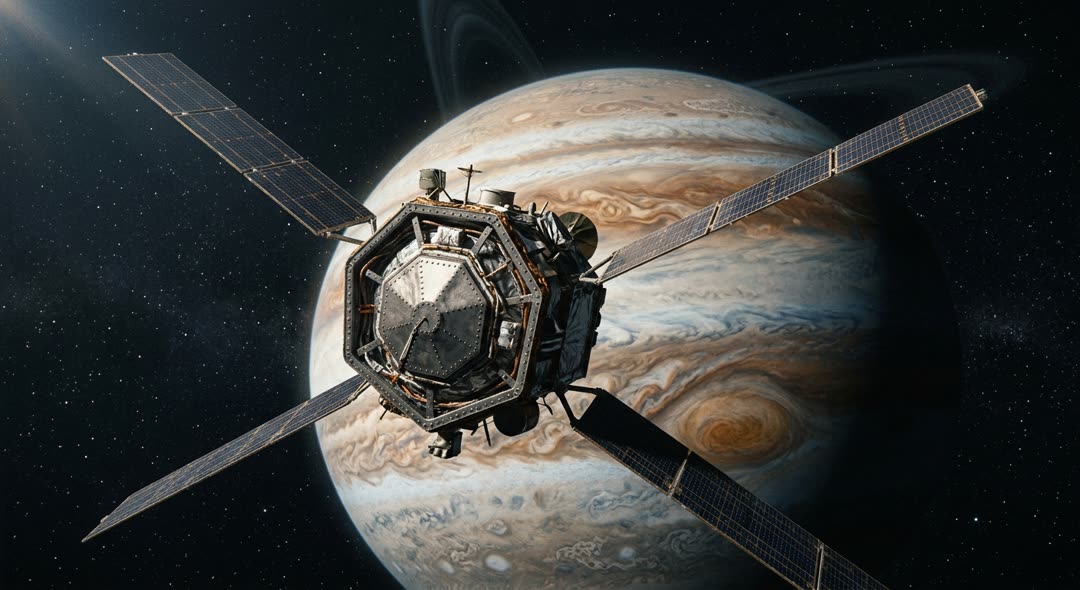
Four hundred pounds of titanium, wrapped around a box of electronics, hurtling toward Jupiter at speed. Inside that vault sat the command and data handling systems, the fragile brain of the spacecraft. Around it, the diaphanous rings waited.
At 11:18 p.m. Eastern time, Juno’s main engine began to fire. In the mission operations center at NASA’s Jet Propulsion Laboratory in Pasadena, California, scientists watched and waited for the burn to slow the spacecraft enough for Jupiter’s gravity to capture it. Juno had already passed through the plane of the planet’s rings during its approach, a stretch where a single speck of dust could have torn into it. Now the engine worked to place it in orbit.
NASA built Juno as the second spacecraft under its New Frontiers Program, after New Horizons flew to Pluto. Named for the Roman goddess who could see through clouds, it was built to study the planet that Galileo Galilei, the Italian astronomer who first spotted Jupiter’s four great moons in 1610, had watched through a telescope. The spacecraft crossed 1.7 billion miles over five years to reach it.
Scott Bolton, the mission’s principal investigator at the Southwest Research Institute in San Antonio, knew radiation was the main factor limiting the spacecraft’s life. Heidi Becker, leader of Juno’s radiation monitoring team, called the region over Jupiter’s north pole “the scariest part of the scariest place.” The planet waited.
In the days before, Juno had been on its own since Thursday, running a programmed sequence with every scientific instrument switched off. On Sunday it passed within the orbits of Callisto and Ganymede; on Monday it swept past Europa and Io. As Jupiter’s gravity ensnared it, the spacecraft accelerated toward its rendezvous, up to 130,000 miles per hour.
Just before the burn, Juno fired its thrusters to spin faster, from two to five revolutions per minute, for stability. At about 10:30 p.m. Eastern time it plunged over Jupiter’s north pole and through the belt of radiation Becker had feared. Then came the Jupiter Orbit Insertion burn, the maneuver that would slow it enough for Jupiter’s gravity to capture it, carrying the spacecraft through the thirty-five minutes that decided whether there would be a mission at all.
The burn shed 1,212 miles per hour from Juno’s speed. At 11:53 p.m. Eastern time, a signal reached Pasadena announcing the engine had finished and orbit was obtained, a message that took forty-eight minutes to cross the distance from the spacecraft. Juno settled into a 53.5-day capture orbit, the long loop chosen to save fuel.
The same plan that placed Juno in orbit had already fixed the date of its end. Its deorbit burn was scheduled for the thirty-seventh orbit, on February 20, 2018, a maneuver meant to send the spacecraft down into Jupiter’s atmosphere at 34 degrees north latitude. The arrival and the fall were written into the same sequence.
Juno was circling Jupiter.
Juno was a spacecraft made of titanium, wrapped around a box of electronics. Inside sat the command and data handling systems, the fragile brain of the spacecraft.
At 11:18 p.m. Eastern time, Juno’s main engine began to fire. Scientists watched at NASA’s Jet Propulsion Laboratory in Pasadena, California. They waited for the burn to slow the spacecraft. Then Jupiter’s gravity could capture it. During its approach, Juno had already passed through the plane of the planet’s rings. A single speck of dust could tear into it.
NASA built Juno as the second spacecraft under its New Frontiers Program. The first was New Horizons, which flew to Pluto. Juno was named for the Roman goddess who could see through clouds. It was built to study Jupiter. Galileo Galilei was an Italian astronomer. He first spotted Jupiter’s four great moons in 1610. Juno crossed 1.7 billion miles over five years to reach the planet.
Scott Bolton was the mission’s lead scientist at the Southwest Research Institute in San Antonio. He knew radiation was the main thing limiting the spacecraft’s life. Heidi Becker led Juno’s radiation monitoring team. She called the region over Jupiter’s north pole “the scariest part of the scariest place.”
Juno had been on its own since Thursday. It ran a programmed sequence with every scientific instrument switched off. On Sunday it passed within the orbits of Callisto and Ganymede. On Monday it swept past Europa and Io. When Jupiter’s gravity caught it, the spacecraft accelerated up to 130,000 miles per hour.
Just before the burn, Juno fired its thrusters to spin faster. It went from two to five revolutions per minute, for stability. At about 10:30 p.m. Eastern time, it plunged over Jupiter’s north pole. It passed through the belt of radiation that Becker had feared. Then came the Jupiter Orbit Insertion burn. This maneuver would slow it enough for Jupiter’s gravity to capture it. Thirty-five minutes decided whether there would be a mission at all.
The burn dropped 1,212 miles per hour from Juno’s speed. At 11:53 p.m. Eastern time, a signal reached Pasadena. It announced that the engine had finished and orbit was obtained. The message took forty-eight minutes to cross the distance from the spacecraft. Juno settled into a 53.5-day capture orbit. This long loop was chosen to save fuel.
The same plan had already fixed the date of Juno’s end. Its deorbit burn was scheduled for the thirty-seventh orbit, on February 20, 2018. The maneuver would send the spacecraft down into Jupiter’s atmosphere. It would fall at 34 degrees north latitude. The arrival and the fall were written into the same sequence.
Juno was circling Jupiter.
Words to learn
Sentence patterns
Scott Bolton, the mission’s principal investigator at the Southwest Research Institute in San Antonio, knew radiation was the main factor limiting the spacecraft’s life.Dr. Lena Cross, the lead engineer on the tunnel project, warned that the drilling could crack the old foundations above.
On Sunday it passed within the orbits of Callisto and Ganymede; on Monday it swept past Europa and Io.In the morning the crew tested the engines; in the afternoon they checked every sensor on the deck.
As Jupiter’s gravity ensnared it, the spacecraft accelerated toward its rendezvous, up to 130,000 miles per hour.As the storm moved inland, the pilots waited on the runway for word that it was safe to take off.
When Jupiter’s gravity caught it, the spacecraft accelerated up to 130,000 miles per hour.When the rain stopped, the children ran outside to play.
At 11:53 p.m. Eastern time, a signal reached Pasadena.At nine o’clock, the shop opened its doors.
It was built to study Jupiter.The bridge was built to connect the two towns.

Discussion questions
- The same plan that placed Juno in orbit had already fixed the date of its end. Why might engineers decide a spacecraft’s destruction at the same moment they plan its arrival, and how do you feel about building an ending into something from the very start?
- Radiation is described as the main factor limiting Juno’s life, and the region over the north pole is called “the scariest part of the scariest place.” How does the story show the team pressing on despite a danger they could not remove, and when have you had to move ahead with something risky you couldn’t fully control?
- Juno settled into a long 53.5-day capture orbit chosen to save fuel rather than a faster path. What does the story suggest about the trade-off between conserving resources and reaching a goal quickly, and how do you weigh that kind of choice in your own decisions?
- Juno’s team was afraid of the radiation near Jupiter. Do you think it is worth taking big risks to learn new things? Why?
- Juno traveled for five years to reach Jupiter. Would you like to work on a project that takes many years to finish? Why or why not?
- Scientists watched and waited during the burn. Do you think waiting is harder than acting? Why do you think so?