The Laser With Empty Batteries
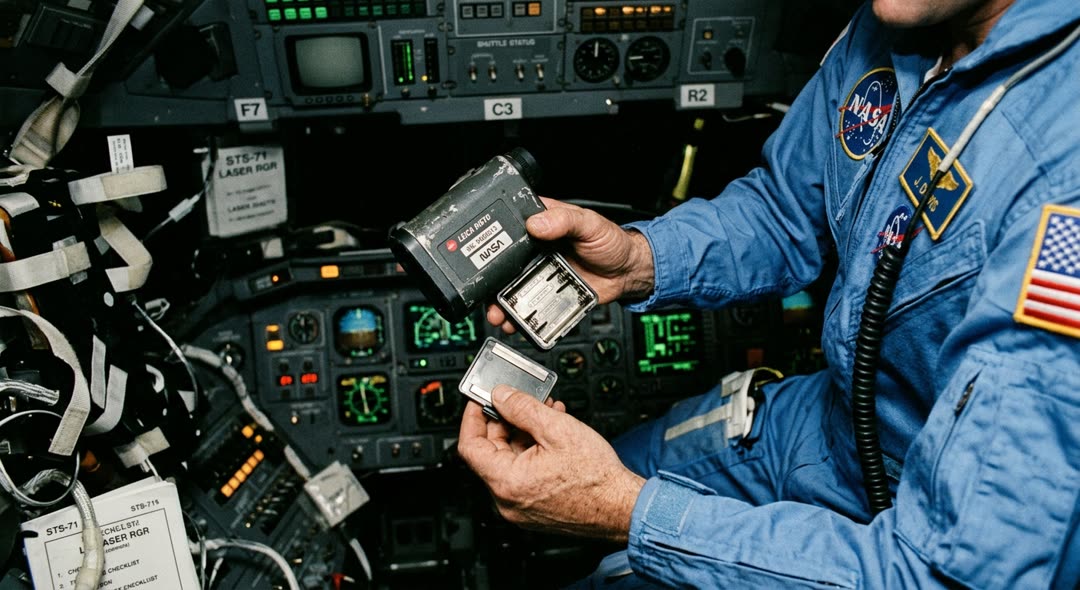
Empty battery packs. The crew pulled out the hand-held LIDAR laser rangefinder and found nothing inside it, no batteries installed at all. They rigged it to draw power from the Orbiter through a break-out box and kept closing on the target.
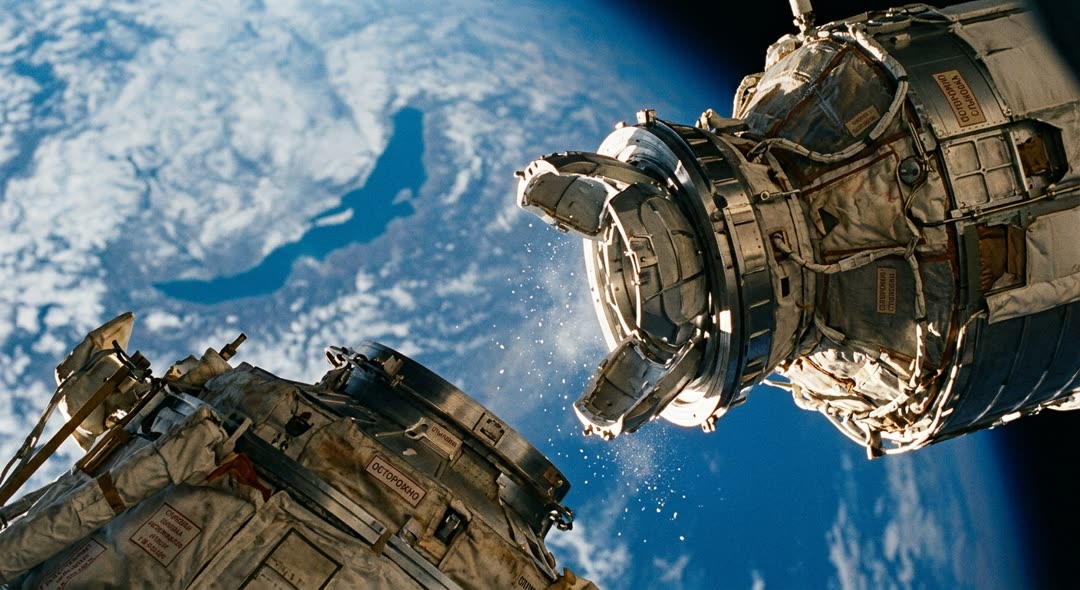
On June 29, 1995, high above Lake Baikal, Atlantis moved toward the Mir space station. It was the first joint United States-Russian docking since 1975, when the Apollo-Soyuz Test Project last brought the two nations’ spacecraft together, and the first of seven planned Shuttle-Mir missions during Phase 1 of the Space Station Program. The Orbiter Docking System, developed jointly by RSC Energia of Kaliningrad, Rockwell International of Downey, California, and NASA, had been powered up for the approach. At its heart sat the Androgynous Peripheral Docking System, a 632-pound Russian-built mechanism with a three-petal capture ring mounted on six interconnected ball screw shock absorbers.
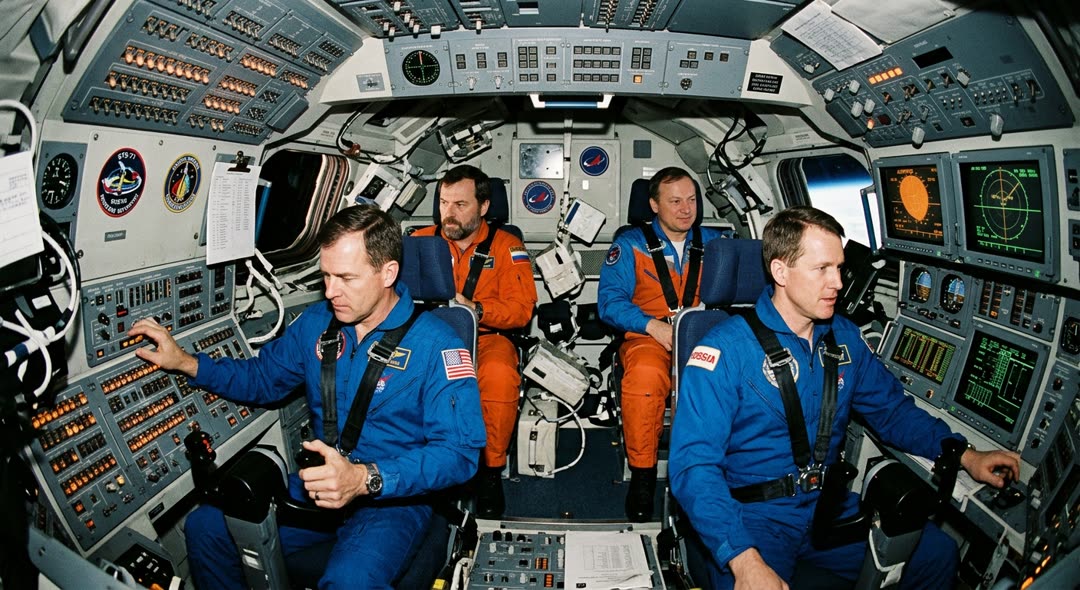
Robert “Hoot” Gibson, a U.S. Navy captain on his fifth spaceflight, commanded Atlantis from the front deck, with pilot Charles Precourt beside him. Behind them rode the two men they were delivering, Mir-19 Commander Anatoly Solovyev on his fourth flight and Flight Engineer Nikolai Budarin on his first. Weather had already scrubbed two attempts. The launch set for June 23 died when lightning kept the team from loading propellant into the External Tank, a second try on June 24 fell apart near the end of the T-9 minute hold, and a three-day stand-down followed the forecast of more of the same.
Up on Mir, Norman Thagard had been waiting since March 14, when he became the first American astronaut launched into orbit on a Russian rocket. He had ridden up with the Mir-18 crew, Commander Vladimir Dezhurov and Flight Engineer Gennady Strekalov, and every scrubbed launch left the three of them in orbit a little longer.
Atlantis rises toward Mir along the R-Bar, the Earth radius vector, climbing from a point directly below the station so the thin pull of the atmosphere helps brake the closing rate instead of fuel. Partway up the approach, General Purpose Computer number four falls out of step with GPC 1, which declares it failed, most likely a radiation upset that flipped a bit somewhere in its memory. Gibson keeps flying.
He brings the Orbiter in at a closing rate very near the targeted 0.1 foot per second. The two spacecraft touch over Lake Baikal, and at the instant of contact the lateral misalignment is less than one inch and the angular misalignment less than half a degree on every axis. Capture comes at 13:00:13.9 Greenwich mean time.
The peak axial load runs to about 1,000 kilograms, roughly half what the six ball-screw shock absorbers are built to absorb. Eight minutes later the twelve structural latches drive home at 13:08:17.9 Greenwich mean time, and Atlantis and Mir become one machine.
The whole approach had come down to inches and fractions of a degree, the kind of accuracy you build six interconnected ball screw shock absorbers to receive. And the hand-held LIDAR laser rangefinder that helped read the closing distance had been pulled out empty, its battery packs holding nothing, the batteries never installed. The crew wired it into the Orbiter through a break-out box and went on closing the gap.
Solovyev and Budarin had ridden up to relieve a crew, and once the latches held, the way through to Mir-18 lay open at last. Norman Thagard, the first American to reach orbit on a Russian rocket and the first to live aboard Mir, had been waiting since the fourteenth of March for the other side of that hatch.
The crew pulled out the LIDAR laser rangefinder. They found nothing inside it. The batteries were never put in. So they wired it to the Orbiter through a break-out box and kept going.
On June 29, 1995, high above Lake Baikal, Atlantis moved toward the Mir space station. It was the first joint United States-Russian docking since 1975. That year, the Apollo-Soyuz Test Project last brought the two nations’ spacecraft together. It was also the first of seven planned Shuttle-Mir missions during Phase 1 of the Space Station Program.
The Orbiter Docking System was powered up for the approach. It was developed by RSC Energia of Kaliningrad, Rockwell International of Downey, California, and NASA. At its heart sat the Androgynous Peripheral Docking System. This was a 632-pound Russian-built machine with a three-petal capture ring on six ball screw shock absorbers.
Robert “Hoot” Gibson, a U.S. Navy captain on his fifth spaceflight, commanded Atlantis. Pilot Charles Precourt sat beside him. Behind them rode two men they were delivering. They were Mir-19 Commander Anatoly Solovyev, on his fourth flight, and Flight Engineer Nikolai Budarin, on his first.
Weather had already scrubbed two attempts. The launch set for June 23 died when lightning stopped the team from loading propellant. A second try on June 24 fell apart near the end of the T-9 minute hold. Then a three-day stand-down followed.
Up on Mir, Norman Thagard had been waiting since March 14. He became the first American astronaut launched into orbit on a Russian rocket. He had ridden up with the Mir-18 crew, Commander Vladimir Dezhurov and Flight Engineer Gennady Strekalov. Every scrubbed launch left the three of them in orbit a little longer.
Atlantis rose toward Mir along the R-Bar, the Earth radius vector. It climbed from a point directly below the station. This way the thin pull of the atmosphere helped slow the closing rate instead of fuel.
Partway up the approach, General Purpose Computer number four fell out of step with GPC 1. GPC 1 declared it failed. This was most likely a radiation hit. The hit flipped a bit in its memory. Gibson kept flying.
He brought the Orbiter in at a closing rate very near the targeted 0.1 foot per second. The two spacecraft touched over Lake Baikal. At that moment the lateral misalignment was less than one inch. The angular misalignment was less than half a degree on every axis. Capture came at 13:00:13.9 Greenwich mean time.
The peak axial load ran to about 1,000 kilograms. That was roughly half what the six ball-screw shock absorbers are built to absorb. Eight minutes later the twelve structural latches drove home at 13:08:17.9 Greenwich mean time. Atlantis and Mir became one machine.
Solovyev and Budarin had ridden up to relieve a crew. Once the latches held, the way through to Mir-18 lay open at last. Norman Thagard had been waiting since the fourteenth of March for the other side of that hatch.
Words to learn
Sentence patterns
Robert “Hoot” Gibson, a U.S. Navy captain on his fifth spaceflight, commanded Atlantis from the front deck, with pilot Charles Precourt beside him.Maria Santos, a marine biologist on her third expedition, guided the small submersible down toward the reef.
It was the first joint United States-Russian docking since 1975, when the Apollo-Soyuz Test Project last brought the two nations’ spacecraft together, and the first of seven planned Shuttle-Mir missions during Phase 1 of the Space Station Program.It was the first solo winter crossing of the strait in a decade, when no other sailor had been willing to face the currents.
Atlantis rises toward Mir along the R-Bar, the Earth radius vector, climbing from a point directly below the station so the thin pull of the atmosphere helps brake the closing rate instead of fuel.The diver dropped along the anchor line, descending toward the wreck so the slow current would carry her gently to the hull.
The launch set for June 23 died when lightning stopped the team from loading propellant.The match stopped when the rain started.
Norman Thagard had been waiting since March 14.She had been studying since early morning.
Gibson kept flying.The teacher closed the door.
Discussion questions
- After the crew found the rangefinder empty and watched a flight computer drop out partway up, they kept closing on Mir anyway. How does the story show the crew working around equipment problems, and how do you respond when tools fail at a critical moment in your own work?
- Norman Thagard had been in orbit since March 14, and every scrubbed launch left him and the Mir-18 crew waiting a little longer. What does the story suggest about waiting on something you cannot control, and when have you faced a delay like that yourself?
- The docking came down to inches of lateral offset and fractions of a degree on every axis. Why do you think that level of precision mattered so much for this approach, and where in your own life do small margins make a real difference?
- Do you think the crew were right to keep going after they found the rangefinder empty? Why?
- Norman Thagard had to wait many extra days in orbit. Would you like to live in space for a long time? Why?
- Why do you think the United States and Russia wanted to work together in space?